Thursday, September 17, 2009

Physically Straightening the Circle

Continuing my riff on whether arc lengths are fully commensurate with radial or linear lengths. We certainly seem to have the ability to physically straighten out a circle. Take a circular object like a hula hoop, cut it, and simply flatten it into a straight line. Measure the distance with a ruler and voila, we have converted arc length into linear length.Or dip the hoop in paint and roll it one complete revolution on a flat surface. Measure the length of the mark left on the surface and voila we have done it again. Arc length converts into radial length. Problem solved right?


Not precisely. Any physical object we can mold into a circle and then straighten out again is going to have a characteristic stretch to it (I believe the technical term is "ductile"). The length when it is straightened is going to depend on how ductile the material composition is. Different materials will stretch out differently. Which one will give us the correct linear conversion of a circular object of a fixed radius?


Similarly the ability of a circular object to move on a flat surface depends on static friction. No friction, no forward motion. Picture a tire spinning on ice. But the friction between a surface and a wheel can vary and hence the forward motion in one rotation will not be precisely the same for any two differently composed wheels or surfaces.


Yes I know they will be close and if most circular objects of fixed radius unbend and yield close to the same liner distance, why quibble? Close enough for government purposes, right? Always the querulous quibbler.


Maybe, but maybe not. Maybe the fact that the constant of proportionality, Pi ,by which we relate a liner measure ( radial length) to arc length (circumference) cannot be represented by a fixed or even repeating decimal reflects something fundamental about the physical universe?

Tuesday, September 1, 2009

Clarification on Fundamental and Derivative Physical Measurements: What about Clocks?

I made, in the last post, what was probably a rash and incorrect speculation: I said that the straight edge and protractor are the fundamental physical measuring devices and that all others are derivative from these. Well clearly we need to add clocks to the list. Or do we?

Well a straight edge and a protractor are easily constructed and they are literally all the same (or perhaps I should say that they are all geometrically similar). But clocks are a great deal more complex.

Clocks all seek incremental measurements of time in an analogous manner to the way straight edges seek to measure length and protractors seek to measure angles. But unlike the cases of length and angle, the measurement of time increments is a much more derivative and tricky affair. We have direct measurement access to lengths and angles but we do not have direct access to time. Only through the observation of some natural or engineered process are we able to infer increments of time. By its very nature a process involves the movement or change of some observable object over time.

However a merely observable process will not suffice to serve as a clock. For a process to be utilized as a clock an object must go through repetitive or cyclical change. The beatings of our heart, the movement of a shadow in the sun, or the vibrations of a spring are the traditional components of both natural and engineered clocks.

Does the use of a clock require the use of a meter stick or protractor? Obviously not. To use a clock to determine an increment of time entails simply being able to observe an end point to a process. For example if we have an hour glass all we have to observe is that all the sand at the top of the glass has flowed into the bottom part in order to infer that an hour of time has elapsed. To see that five minutes have elapsed on a traditional non digital watch we need only observe the beginning and end of the movement of the minute hand through the arc length between any standard demarcated five minute interval.

So a clock is a fundamental measuring device as opposed to a derivative one.

Clarification on Fundamental and Derivative Physical Measurements: What about Clocks?

I made, in the last post, what was probably a rash and incorrect speculation: I said that the straight edge and protractor are the fundamental physical measuring devices and that all others are derivative from these. Well clearly we need to add clocks to the list. Or do we?

Well a straight edge and a protractor are easily constructed and they are literally all the same (or perhaps I should say that they are all geometrically similar). But clocks are a great deal more complex.

Clocks all seek incremental measurements of time in an analogous manner to the way straight edges seek to measure length and protractors seek to measure angles.
But unlike the cases of length and angle, the measurement of time increments is a much more derivative and tricky affair. We have direct measurement access to lengths and angles but we do not have direct access to time. Only through the observation of some natural or engineered process are we able to infer increments of time. By its very nature a process involves the movement or change of some observable object over time.

However a merely observable process will not suffice to serve as a clock. For a process to be utilized as a clock an object must go through repetitive or cyclical change. The beatings of our heart, the movement of a shadow in the sun, or the vibrations of a spring are the traditional components of both natural and engineered clocks.

Does the use of a clock require the use of a meter stick or protractor? Obviously not. To use a clock to determine an increment of time entails simply being able to observe an point to a process. For example if we have an hour glass all we have to observe is that all the sand at the top of the glass has flowed into the bottom part in order to infer that an hour of time has elapsed. To see that five minutes have elapsed on a traditional non digital watch we need only observe the beginning and end of the movement of the minute hand through the arc length between any standard demarcated five minute interval.

So a clock is a fundamental measuring device as opposed to a derivative one.

Saturday, August 22, 2009

Measuring Lengths and Angles: Derived and Direct Physical Measurements

In the previous posting I argued that I was queasy about the idea of claiming that the radian measure was unitless. The claim that the radian measure was unitless is based on the definition of an angle as:

Theta= S/R

where S is the arc distance associated with the given central angle of a circle of radius R. R is the radius of the circle.

The claim is that arc distance and radial distance can be measured in the same physical units. My counterargument is that there are fundamental ontological differences between curved and straight lines and these differences merit utilizing distinct dimensional units.

I would argue that the dimensional units appropriate to arc length measures derive directly from definitional equation:

S = theta x R

S = Radian x Meters


So I would measure arc length in radian-meters, rather than just meters.

Thus to the extent we are interested in measuring arc lengths (and we are not usually interested in this measure) we should utilize a derived unit measure. The distinction between derived and direct measurement bears greater scrutiny.

Speculations on Direct and Derived Measurements

In physics there are only two types of measurement: direct and derived. I suspect that there are only two direct possible physical measurements and that all other measurements are ultimately derived from these two. Under proper conditions we can construct physical devises that allow the direct measurement of length and of angles. All other measurements are ultimately derivative from these two. All measurements are also based on fundamental beliefs (axioms) about the nature of the physical world. In other words measurements are theory laden. But, almost none of these fundamental beliefs are very controversial. I will have more to say on these points in later posts. For now I want to look very closely at the physical construction of the straight edge and the protractor.

The Straight Edge

Any straight object such as a taut string or strip of cloth can be used to fashion a more durable meter or yard stick. The unit length is a matter of convention (but a very important convention). There is no natural unit of gradation. To deploy a meter or yard stick usually entails an alignment process which in turn requires approximation because precise measures with a yard stick require straight edges on the object to be measured. For objects with highly irregular shapes calipers can be used. Measurements of area and volume derive directly from the measures of length. Maintaining bars representing conventional units of length and assuring the reproduction of faithful copies has been a matter of great commercial and scientific importance.

The Protractor

Any semi-circle disc can serve as a measure of angles. A circle or a semi circle can in turn be drawn and hence used to construct a protractor using only a compass, which in turn can be a device as rudimentary as a taut string with a marker on the end. So it does not take much to construct a protractor.

Further, because we can bisect any angle with just a straight edge and a compass we can create equal gradients on a compass without resorting to the heroic efforts needed to replicate and define our conventional units of linear length such as the meter or yard. In effect the circle or semi circle is naturally divisible into equal units. For example, dividing the straight line (a.k.a. straight angle) in two, gives us 90 degrees or pi/2 radians. Bisecting this angle again gives us 45 degrees or pi/4. And we can go on bisecting to create more and more refined angle measures with simply a straight edge and a compass, neither of which needs any unit gradations of any sort.

Finally, we do not need to specify any specific sized protractor because all circles are proportional and the angle gradients constructed on one sized protractor will yield equivalent angle measures on any other sized protractor. Of course the arc lengths between gradients on one sized protractor will differ on different sized protractors. But as noted above we normally are not interested in measuring arc lengths but rather angles.

Wednesday, August 19, 2009

More on Radian Measurements: Some R and R? Some Stretching of the Truth?

You can see from my earlier post that I wondered how any trig function could have a dimensionless real number as an argument. The answer probably stems from a mathematical sleight of hand wherein the radian measure of an angle is treated as being dimensionless.

I quote here from "Analytic Trigonometry with Applications" by Ray Barnett Wadsworth Publishing 1992 edition .

Barnett begins by describing a central angle subtended by an arc length equal to the radius of the circle as an angle of radian measure 1.
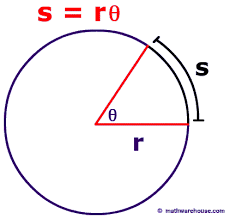


Barnett is saying that the length of S= R for any 1 radian central angle theta.

So we have theta = S/R
S= R x theta

and most importantly Barnett stresses that S and R must be in the same units. As a consequence he further notes that the radian measure becomes a unitless number.

" The units in which arc length and radius are measured cancel; hence we are left with a "unitless" or pure number."


So if Barnett is correct than any angle (defined as the ratio of an arc length on the circumference of a circle to the radial length of a circle) can be reduced to a "unitless" real number and voila we have the ability to use real numbers as preimages of trig functions.

And to this I say not so fast. I say there are fundamental differences between any curved line (such as an arc length) and any straight line(such as a radius). These differences ought to give us pause before we say that the units of our numerator S will cancel with our units of our denominator R. Here are three differences between curved and straight lines that concern me:

(i) Fundamental differences in physical measurement technology
(ii) Fundamental differences in the laws of physics
(iii) Fundamental functional differences in analytic geometry

Fundamental Differences in Physical Measurement Technology

We can directly measure the length of a straight line with a graded straight edge or meter stick. We cannot directly measure the length of a curved arc length, S. The equal gradient marks on a protractor are measures of the ratio of S/R and not the length of S. We establish equal gradients on a protractor by virtue of our ability to bisect any angle with just a straight edge and a compass.

In theory, we might be able to measure an arc length with a straight edge by chopping the straight edge up into smaller and smaller segments but there is a physical or technological limit as to how far this chopping up and aligning will take us.

Fundamental Laws of Physics

As a thought experiment you might say that if I could traverse a given straight line traveling at a fixed velocity in a certain time interval, then I could operationally define an equal arc length as the distance traversed on the arc in the identical time interval. The problem of course is that I can traverse a straight line with a fixed velocity but I cannot do so while traversing a curved line. Motion along a curved line must involve variable, not fixed velocity. Curved motion is accelerated; it involves the application of a continuous net force. No net force is required to traverse a straight line.

Fundamental Functional Differences in Analytic Geometry

In a Cartesian coordinate system a straight line cannot be represented with a power term. A straight line must have this functional form y= ax +b. A curved line can only be constructed only when a power term is present e.g., y= x^2 .


Preliminary Summary

The above three fundamental differences between straight and curved lines as reflected in physical technology, the laws of physics and in analytic geometry to my way of thinking seem to point to some very fundamental ontological differences between the curved and the straight lines. These differences ought to give us at least some pause in saying that unit arc lengths are equivalent to unit radial lengths.

Response to Posting on Waves and Trig Functions

Here is a response to the previous posting form a pal and his son:

Mike,
 
So...one way to try to understand a complicated idea is to attempt to reverse engineer

it using your knowledge and physical intuition. Kudos for that. If you reach a dead
end, you would at least have the satisfaction of uncovering the area you need to focus
on next in your education.


In this case you are in luck. Since the harmonic wave function is a product of hundreds
of years of brilliant mathematicians describing what they've observed in nature
(everything vibrates: light, sound, objects, people, etc.), it is an incredibly elegant
way of representing exactly what is going on.

In order to resolve the apparent conundrum in your mind that the units don't match in the
harmonic wave function, you have only to realize that they must match, obviously, or it
wouldn't be a world-renowned description of how things work. This should encourage you to
continue your quest to understand the nuts and bolts of how and why.

To your credit this is not a simple subject. There is a lot going on in that equation so it
is good that you are intrigued by the fact that a single equation or a single argument in an
equation can describe a position, a time and modulation from the pattern with all the units
still matching. The good news is that thousands of people teach and learn this very equation
every year. For example, a class in structural dynamics can be all about vibrations and learning
exactly how to manipulate the harmonic wave equation to efficiently design complex physical structures. 

In fact there is a book, Fundamentals of Vibrations by Leonard Meirovitch, that might be just the ticket.
Apparently the current version is rather expensive but you can get an older one, used, online for
considerably less.
 
It is cool that you are challenging these equations based on your intuitions; however, with a little more

background...chances are good that you'll come to realize the true elegance of the harmonic wave function.
 
Respectfully Submitted,
Randy Brown paraphrasing son Alex, a graduate student in aerospace engineering


Sunday, August 16, 2009

Conundrum: Representing Harmonic Waves with Sine Functions

It is claimed that a one dimensional harmonic wave can be represented by the following function

Y = A sin(kx-wt + B)

Where x = location

A = amplitude

K = wave number

w = angular frequency

B = phase adjustment parameter

Here is the conundrum. Can any quantity other than an angle be an argument for a trigonometric function? Let's simplify the problem and ask how can a function such as

Y = sin(x) be interpreted where x is simply a real number representing a geometric position?

In the development of trigonometry we have two methods of defining specific functions. The most rudimentary method is to define them in terms of right triangles.

For example

Sin (theta) = opposite side/ hypotenuse

In this primitive approach right triangles are drawn and it is clear that the argument or preimage of the function is an "angle" and the images of the functions are the ratios of varying sides of the right triangle. In this definitional approach everything relies pretty much on geometric intuitions.

The more sophisticated and general approach is to define the angle q in terms of a unit circle. In this definition the range of the functions become the ratios of coordinates of points on the circumference of the circle divided by the radius of the circle. For example

Sin (theta) = Y/ R

In this approach the angle q is now given a more explicit definition as the ratio of S, an arc length of the circle, divided by the radius of the circle. i.e. theta = S/R

The Y in the above functional definition is the y coordinate of the end point of an arc segment S on a circle of radius r. So literally the trig functions become mappings of ratios. The pre images of the functions are ratios of arc lengths over radial lengths. The images of the functions are ratios of coordinate lengths over radial lengths.

These definitions have physical interpretations as physical units. The angle, the preimage ratio, has units called radians. The image units are simply whatever convenient unit of length we happen to use: meters or yards.

Given the more formal physical definition of angles, the conundrum is this: how do we give physical meaning to sin (x) where x is simply a unit of length from some arbitrary point of origin in some physical reference frame?

In physics, units matter and they matter a lot. Returning to the more complicated harmonic wave function:

Y = A sin(kx-wt + B)

Here we have an even stranger beast showing up as the preimage of the function. In dimensional terms kx would be in meters while "wt" reduces to radians. So the preimage is some kind of mixed unit involving a subtraction of radians from meters!

Now in physics there are many combinations of physical units involving multiplication and division (e.g. v=m/s). But how do we interpret the addition or subtraction of distinct physical units? I'm not sure we can?

Who out there can help me with this conundrum?