I quote here from "Analytic Trigonometry with Applications" by Ray Barnett Wadsworth Publishing 1992 edition .
Barnett begins by describing a central angle subtended by an arc length equal to the radius of the circle as an angle of radian measure 1.
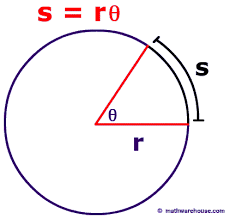
Barnett is saying that the length of S= R for any 1 radian central angle theta.
So we have theta = S/R
S= R x theta
and most importantly Barnett stresses that S and R must be in the same units. As a consequence he further notes that the radian measure becomes a unitless number.
" The units in which arc length and radius are measured cancel; hence we are left with a "unitless" or pure number."
So if Barnett is correct than any angle (defined as the ratio of an arc length on the circumference of a circle to the radial length of a circle) can be reduced to a "unitless" real number and voila we have the ability to use real numbers as preimages of trig functions.
And to this I say not so fast. I say there are fundamental differences between any curved line (such as an arc length) and any straight line(such as a radius). These differences ought to give us pause before we say that the units of our numerator S will cancel with our units of our denominator R. Here are three differences between curved and straight lines that concern me:
(i) Fundamental differences in physical measurement technology
(ii) Fundamental differences in the laws of physics
(iii) Fundamental functional differences in analytic geometry
Fundamental Differences in Physical Measurement Technology
We can directly measure the length of a straight line with a graded straight edge or meter stick. We cannot directly measure the length of a curved arc length, S. The equal gradient marks on a protractor are measures of the ratio of S/R and not the length of S. We establish equal gradients on a protractor by virtue of our ability to bisect any angle with just a straight edge and a compass.
In theory, we might be able to measure an arc length with a straight edge by chopping the straight edge up into smaller and smaller segments but there is a physical or technological limit as to how far this chopping up and aligning will take us.
Fundamental Laws of Physics
As a thought experiment you might say that if I could traverse a given straight line traveling at a fixed velocity in a certain time interval, then I could operationally define an equal arc length as the distance traversed on the arc in the identical time interval. The problem of course is that I can traverse a straight line with a fixed velocity but I cannot do so while traversing a curved line. Motion along a curved line must involve variable, not fixed velocity. Curved motion is accelerated; it involves the application of a continuous net force. No net force is required to traverse a straight line.
Fundamental Functional Differences in Analytic Geometry
In a Cartesian coordinate system a straight line cannot be represented with a power term. A straight line must have this functional form y= ax +b. A curved line can only be constructed only when a power term is present e.g., y= x^2 .
Preliminary Summary
The above three fundamental differences between straight and curved lines as reflected in physical technology, the laws of physics and in analytic geometry to my way of thinking seem to point to some very fundamental ontological differences between the curved and the straight lines. These differences ought to give us at least some pause in saying that unit arc lengths are equivalent to unit radial lengths.


No comments:
Post a Comment